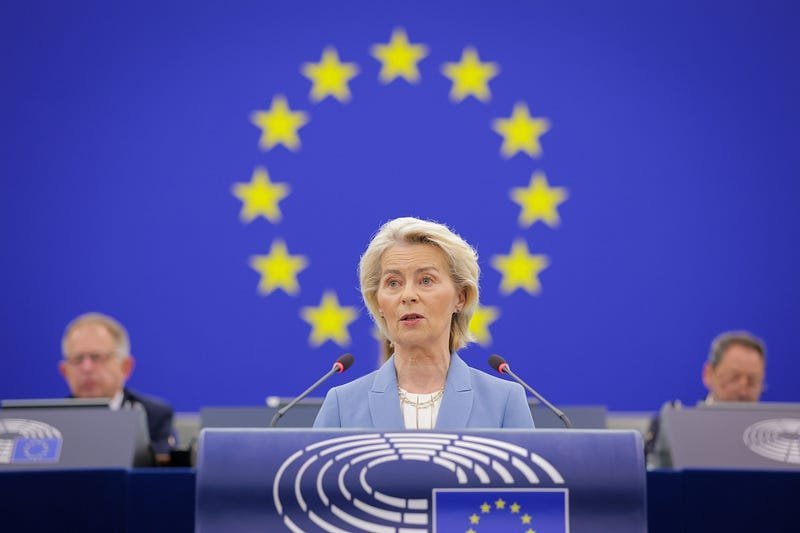
European Commission President Ursula von der Leyen enters a decisive week of high-stakes diplomacy in Strasbourg and Brussels as her flagship vision for a more autonomous, globally competitive European Union faces severe financial pushback from member state capitals. Ahead of Thursday's emergency European Union leaders' summit on November 26, European Council President António Costa circulated a revised compromise for the bloc's 2028–2034 long-term budget that slashes roughly €204 billion from the Commission's original two-trillion-euro spending blueprint. The proposed reductions target core pillars of von der Leyen's second-term agenda—including the European Competitiveness Fund, joint defense initiatives, and external aid—prompting more than 75 major European clean-technology and industrial firms on Monday, November 23, to warn leaders that gutting the fund will leave Europe permanently trailing the United States and China.
The fiscal standoff pits von der Leyen and the European Parliament against a coalition of fiscally conservative nations led by German Chancellor Friedrich Merz, who insists that national contributions must be curbed despite mounting security threats on Europe's eastern flank. Von der Leyen has repeatedly cautioned that deep reductions to strategic investment programs will undermine Europe's ability to lower energy costs, scale up domestic clean manufacturing, and secure critical raw materials. To offset spending cuts and satisfy frugal capitals without collapsing the budget, Costa's compromise replaces the Commission's earlier corporate lump-sum levy with a proposed three percent digital services tax aimed squarely at large technology companies—a move closely watched in Washington given the risk of retaliatory tariffs from President Donald Trump.
Even as she battles over long-term financing at home, von der Leyen has accelerated the Commission's geopolitical outreach across Europe and Asia over the past 72 hours. On Friday, November 20, she joined Costa and British Prime Minister Andy Burnham in Brussels to seal a landmark UK-EU summit pact eliminating agricultural border checks, linking carbon markets, and launching a youth mobility program. Just twenty-four hours later on Saturday, November 21, von der Leyen celebrated the signing of a comprehensive free trade and investment protection agreement between the European Union and Indonesia, uniting a combined market of 730 million consumers across strategic sectors including electric vehicles, electronics, and pharmaceuticals. Speaking at the ceremony, von der Leyen hailed the pact as one of Brussels' most ambitious agreements in Asia as the bloc works aggressively to diversify supply chains away from overreliance on Washington and Beijing.
Simultaneously, the Commission chief has doubled down on financial and military backing for Kyiv as Russia's war in Ukraine grinds on. On Friday, the European Commission disbursed a record €7.9 billion tranche under the Ukraine Facility—its largest single payment to date—to sustain Ukraine's public administration and reward governance reforms. That payout follows the Commission's November 18 proposal urging EU member states to approve up to €45 billion in additional loans for Ukraine in 2027 to help bridge Kyiv's projected €70 billion fiscal shortfall, a plan von der Leyen personally discussed with Chancellor Merz during talks in Berlin last week.
With the European Parliament opening its November plenary session in Strasbourg on Monday afternoon and national leaders converging on Brussels later this week, von der Leyen's political dexterity faces an immediate stress test. Having staked her 2026 State of the Union platform on completing Europe's single market, slashing bureaucratic red tape, and building a sovereign defense industrial base, the Commission president must now rally lawmakers and reluctant capitals to preserve the financial firepower required to turn those ambitions into reality.