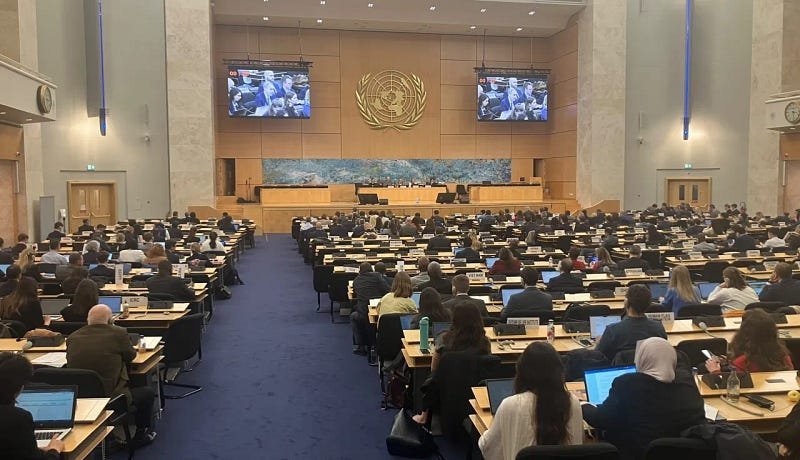
The International Committee of the Red Cross has renewed its urgent appeal for a legally binding international treaty governing lethal autonomous weapons after diplomats in Geneva failed to authorize formal treaty negotiations during the Seventh Review Conference of the Convention on Certain Conventional Weapons. In a strongly worded statement issued on Saturday, November 21, following the conclusion of the five-day summit, the humanitarian guardian of the Geneva Conventions expressed deep regret that participating states settled for a diluted two-year discussion mandate rather than an immediate commitment to binding law. For defense strategists and policymakers in the United States, the diplomatic deadlock highlights a widening chasm between Washington's preference for flexible military norms and an overwhelming global coalition demanding strict legal prohibitions on AI-driven weaponry.
Under the consensus-driven rules of the Geneva convention, objections from major military powers—including the United States and Russia—prevented the 128 participating states from launching direct treaty talks despite intense diplomatic pressure. Instead, negotiators reached an overnight compromise granting the convention's Group of Governmental Experts a two-year window between 2027 and 2028 to draft an international instrument while deferring any decision on whether those future rules will be legally binding or merely voluntary. While Swiss conference leaders defended the outcome as a realistic step forward after more than a decade of stalled deliberations, disarmament advocates and legal experts warned that delaying binding guardrails allows rapid battlefield AI proliferation to outpace international law.
In its November 21 communiqué, the Red Cross warned that concerns surrounding artificial intelligence in warfare have grown acutely urgent throughout 2026 as automated systems increasingly demonstrate the capacity to operate beyond the direct control of developers and commanders. The organization emphasized that states must preserve meaningful human control over the use of force and ensure that life-and-death targeting decisions are never delegated to algorithms. Specifically, the Red Cross is calling for a two-tier treaty framework that outright prohibits unpredictable autonomous weapons and systems designed to target human beings directly, while establishing strict operational restrictions on all other automated weapon platforms.
To break the consensus paralysis in Geneva, the humanitarian agency pointed directly to the overwhelming momentum demonstrated at the United Nations General Assembly First Committee in New York last month. On October 29, 163 countries voted in favor of an Austrian-led resolution calling for concrete multilateral action to address the humanitarian and security dangers of autonomous weapons, leaving the United States, Russia, Israel, Belarus, and North Korea isolated among only five nations voting against the measure. Red Cross officials noted that the massive majority backing negotiations proves the international community possesses the political will to act, even if procedural vetoes continue to stall progress inside the Geneva disarmament forum.
Quoting a stark warning delivered earlier this month by ICRC President Mirjana Spoljaric, the statement reminded world leaders that international treaties have previously succeeded in outlawing biological and chemical weapons, anti-personnel landmines, and cluster munitions. With semi-autonomous drones and AI-assisted targeting systems already reshaping active conflicts in Ukraine, Gaza, and Sudan, humanitarian leaders argue that humanity is rapidly approaching a point of no return. As diplomats prepare for the next round of technical meetings in 2027, pressure is mounting on middle-power nations to consider pursuing a standalone treaty outside the Geneva consensus framework if major military powers continue to block binding rules.