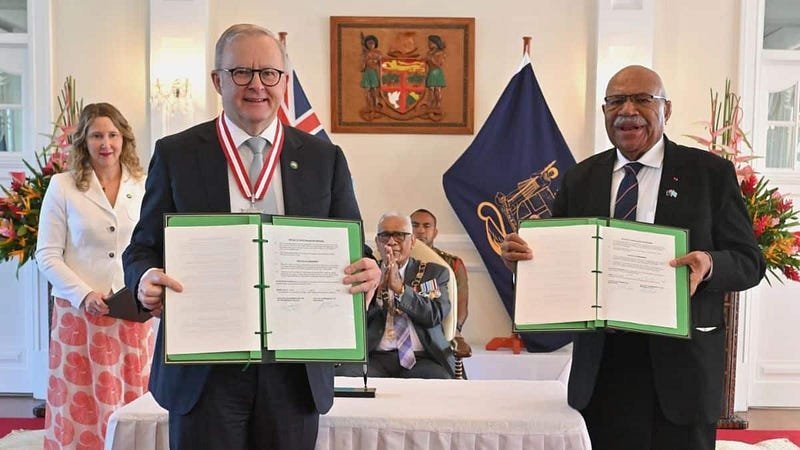
Australia and Fiji officially brought two transformative bilateral treaties into force on Thursday, establishing Fiji’s first-ever formal military alliance and cementing a multi-generational economic and security union that carries major strategic implications for the United States and its Indo-Pacific allies. Australian Prime Minister Anthony Albanese and Fijian Prime Minister Sitiveni Rabuka marked the legal activation of the Vuvale Union and the Ocean of Peace Alliance, formally known as the Veitacini Treaty, through a joint leaders’ statement issued from Canberra and Suva. Originally signed in Suva on July 6, 2026, following a proposal Rabuka first floated in Canberra in July 2025, the twin agreements transition decades of informal cooperation into binding international law.
For policymakers in Washington, the entry into force of the Veitacini Treaty represents a decisive consolidation of allied security architecture across the South Pacific. By binding Canberra and Suva to act together against common armed threats in the Pacific in accordance with their domestic constitutional processes, the pact closes critical strategic gaps along vital maritime corridors linking North America to Australia. The treaty also includes an open accession clause allowing other Pacific Island nations to join by mutual agreement, creating a potential regional security framework led by Pacific states rather than outside powers.
Alongside the mutual defense commitment, the Vuvale Union operationalizes the 2025 Blue Pacific Ocean of Peace Declaration through more than one billion Australian dollars in targeted investments over the next decade. The package allocates substantial grant and loan financing to combat transnational crime and illicit drug trafficking, modernize digital and physical infrastructure, bolster flood and climate resilience, and expand healthcare and educational exchanges. New mobility provisions will also streamline four-month work pathways and five-year business visas between the two nations.
To ensure rapid execution, Canberra and Suva are launching two dedicated governance mechanisms. An officials-level body named Vuvale Bukmak, drawing from a Yolŋu Matha word meaning everyone together, will coordinate day-to-day policy delivery, while a ministerial-level Vuvale Forum will bring cabinet leaders directly together with traditional chiefs, faith groups, and business executives.
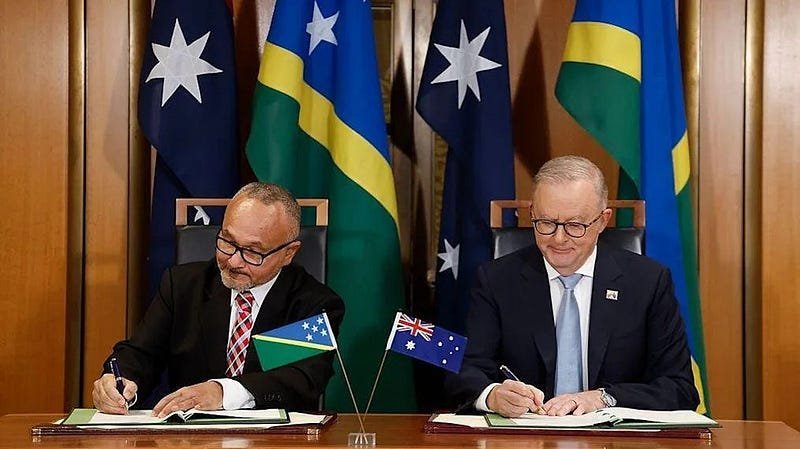
The activation of the Fiji pacts caps an extraordinary week of Pacific diplomacy for the Albanese government, coming just one day after Australia welcomed Solomon Islands Prime Minister Matthew Wale to Canberra to advance a separate bilateral treaty. Together with the Pukpuk Treaty with Papua New Guinea, the Falepili Union with Tuvalu, and the Nauru-Australia Treaty, Canberra has rapidly constructed an interlocking network of Pacific treaties that reinforces regional sovereignty while aligning closely with broader U.S. strategic objectives across the Blue Pacific