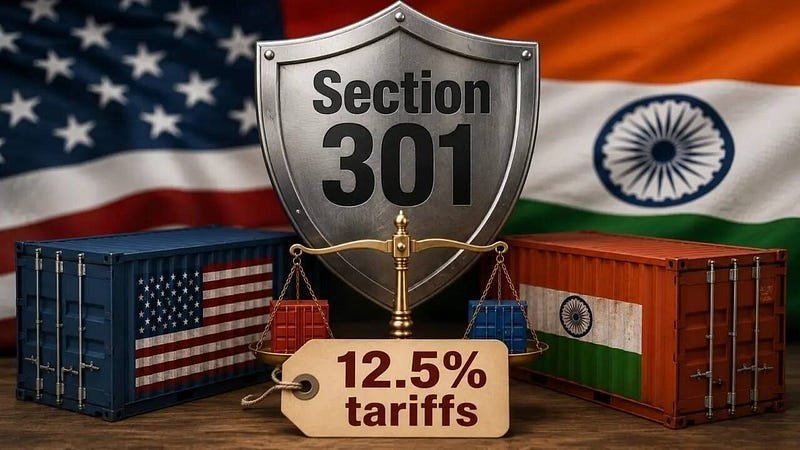
The United States has opened a major new front in global trade policy by proposing sweeping tariffs under Section 301 of the Trade Act of 1974 against 14 major trading partners over alleged industrial overcapacity, setting up months of high-stakes negotiations ahead of planned spring 2027 enforcement.
Announced by the Office of the United States Trade Representative, the blueprint targets China, the European Union, India, Japan, South Korea, Brazil, Taiwan, Switzerland, and seven Southeast Asian nations. Under the proposal, Indian exports face a steep 25 percent duty unless New Delhi and Washington finalize a pending bilateral trade agreement, while Chinese goods face a 20 percent baseline rate that could climb to 40 percent when stacked with existing forced-labor penalties.
For policymakers and corporate leaders across the United States and India, the Section 301 rollout reintroduces acute supply-chain uncertainty following the Supreme Court’s February 2026 ruling invalidating earlier emergency tariffs. While U.S. Trade Representative Jamieson Greer emphasized that the measures are designed to protect domestic manufacturing and encourage reciprocal deals before public hearings begin in January 2027, exporters in Mumbai, Brussels, and Tokyo warned that broad levies risk disrupting industrial inputs and raising costs for American consumers.
---