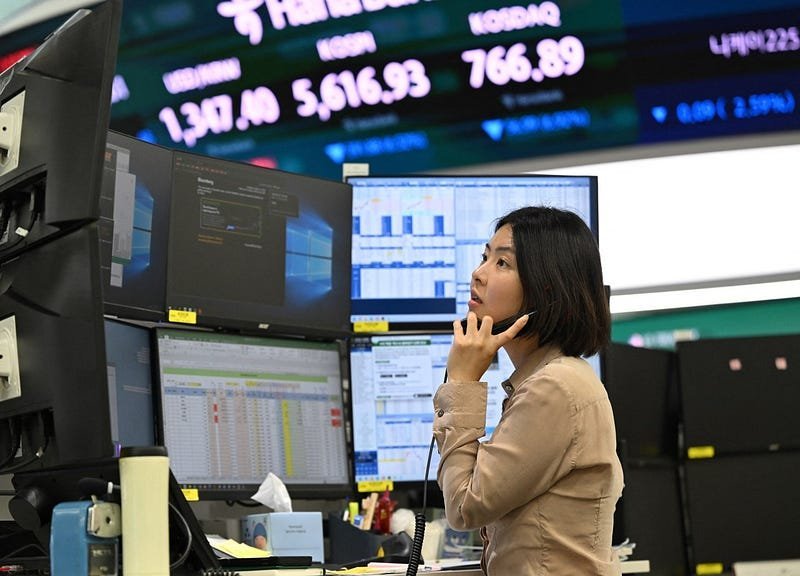
WASHINGTON, D.C., — Global financial markets are catching their breath on Thursday as Asian semiconductor and technology shares staged a broad recovery following a dramatic late-session reversal on Wall Street ahead of the U.S. Thanksgiving holiday, even as accelerating American inflation and mounting scrutiny over debt-fueled artificial intelligence spending keep investors on edge.With U.S. stock and Treasury markets closed Thursday for Thanksgiving, trading momentum shifted to Asia, where beaten-down technology leaders powered regional benchmarks higher. Japan’s Nikkei 225, South Korea’s Kospi, and Taiwan’s Taiex each climbed more than one percent, propelled by double-digit surges in Japanese chipmaker Kioxia and investment giant SoftBank alongside strong gains for Samsung Electronics and SK hynix.
The Asian rebound followed a turbulent pre-holiday session in New York where the Dow Jones Industrial Average erased an early 1,100-point plunge to close up 164 points at 50,182.95, while the S&P 500 dipped 0.25 percent to 7,182.78 and the Nasdaq Composite pared a steep 4.6 percent morning drop to finish down 0.62 percent at 23,585.80. Sentiment stabilized late Wednesday after prominent investor Michael Burry disclosed that his portfolio had shifted largely long, encouraging bargain hunters to step back into bruised equities.
Beneath the holiday calm, however, corporate leaders and institutional investors in the United States face growing macroeconomic headwinds. Fresh Commerce Department data released Wednesday showed the Federal Reserve’s preferred inflation gauge, the Personal Consumption Expenditures index, accelerated to an annual rate of 3.8 percent in October, a three-year high that has strengthened market expectations for an interest rate hike at next month’s central bank meeting. Meanwhile, new U.S. export licensing rules on advanced artificial intelligence chips have begun stalling billions of dollars in Asian data center financing.
Across Silicon Valley, the euphoria surrounding Jensen Huang’s dramatic reinstatement as Nvidia chief executive earlier this week gave way to renewed valuation discipline. Nvidia shares fell 3.9 percent on Wednesday as bond investors demanded wider credit spreads from heavily indebted cloud infrastructure providers such as Oracle and CoreWeave, while newly public artificial intelligence giant Anthropic stabilized near its 83-dollar initial public offering price after five sessions of post-debut volatility.
Elsewhere in global commerce, regional economies showed sharp divergence as policymakers balanced artificial intelligence investment against inflation and trade friction. Singapore raised its full-year 2026 economic growth forecast to roughly six percent after third-quarter output expanded 6.1 percent on surging data center construction, while South Korea’s central bank raised benchmark interest rates to contain price pressures and Indian technology services provider Minfy signed an expanded five-year global artificial intelligence partnership with Amazon Web Services.