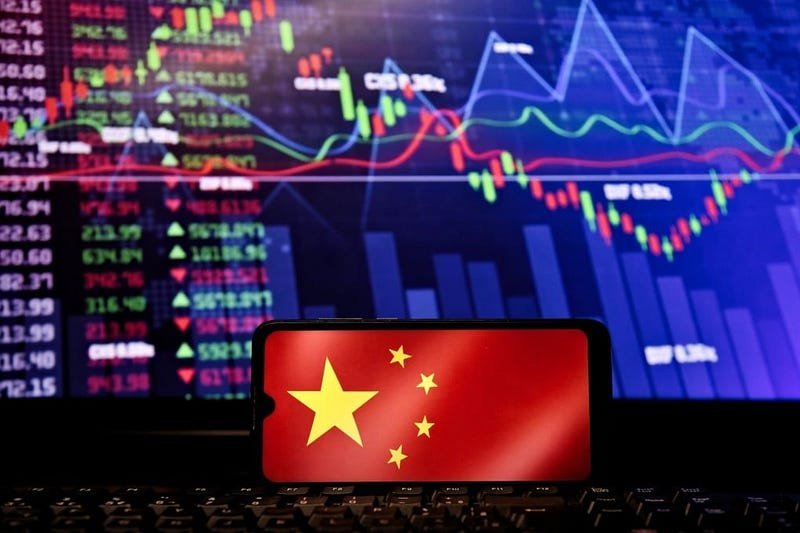
Equity markets across the Asia-Pacific region opened to steep losses on Monday, November 23, as surging anxiety over artificial intelligence valuations and tightening American semiconductor export controls rattled global investors. South Korea's benchmark tumbled more than three percent in early trading—prompting Seoul financial authorities to prepare a market stabilization fund—while major benchmarks in Taiwan, Hong Kong, and mainland China retreated sharply following Friday's technology-led slump on Wall Street. The downturn has been compounded across Southeast Asia by a sweeping new rule from the [U.S. Commerce Department's Bureau of Industry and Security] and barring regional data centers from renting computing power to Chinese technology firms, forcing more than a hundred server projects in Johor and Bangkok to choose between American hardware and Chinese clients.
The financial turbulence arrives on the heels of an intense week of superpower summitry across Manila and Shenzhen that reshaped Indo-Pacific trade and security alignments. During his four-day diplomatic swing through Asia last week, President Donald Trump secured over $17 billion in bilateral commercial and defense agreements—including a $12 billion Boeing and GE Aerospace aircraft deal alongside $2 billion in Foreign Military Financing for the Philippines, as well as a trade pact eliminating Thai tariffs on 99 percent of U.S. exports. While Philippine President Ferdinand Marcos Jr. clarified over the weekend that Manila is pursuing supply diversification rather than sourcing 100 percent of its agricultural imports exclusively from Washington, Trump also convened the first leaders' summit of the Quad security grouping with Australia and Japan in more than two years on the sidelines of the East Asia Summit in Manila.
Simultaneously, regional allies are moving aggressively to insulate supply chains from economic coercion while navigating complex ties with Beijing. Meeting in Tokyo on November 19 for their fourth 2+2 Ministerial Dialogue, Indian and Japanese foreign and defense ministers issued a joint warning against arbitrary export restrictions and launched new frameworks on dual-use semiconductor compliance and research security. Over the weekend at the Halifax International Security Forum, Taiwanese Deputy Foreign Minister Chen Ming-chi cautioned Canadian Prime Minister Mark Carney against deepening trade reliance on Beijing following Carney's tariff-reduction talks with Chinese President Xi Jinping in Shenzhen, warning that Chinese electric vehicles and economic dependence carry severe political and surveillance risks.
Security pressures and domestic crises also dominated headlines across East and Southeast Asia entering the final week of November. In Pyongyang, North Korean leader Kim Jong-un called for heightened military strength amid global security instability as South Korean President Lee Jae-myung urged renewed regional dialogue at APEC, while a generative AI university exam cheating scandal in Seoul forced the resignation of a South Korean cabinet minister on Sunday. Meanwhile, in Indonesia, emergency crews are searching for 36 missing workers after a deadly confectionery factory fire killed at least three people over the weekend, and Australian Prime Minister Anthony Albanese prepares to host Solomon Islands Prime Minister Matthew Wale in Canberra on Wednesday to finalize a landmark Pacific security and development treaty.
From mainland China—where regulators slashed stock margin requirements to 80 percent to inject $56 billion in market liquidity while Ant Group led a $100 million bet on humanoid robotics—to Pacific Island leaders campaigning for $1.5 billion in climate resilience funds after the collapse of COP31, the Asia-Pacific region stands at the epicenter of global economic and geopolitical change. As policymakers in Washington and regional capitals digest the fallout from last week's summits, the collision between American technology restrictions, Asian supply chain realignment, and volatile financial markets will define the Indo-Pacific outlook heading into 2027.