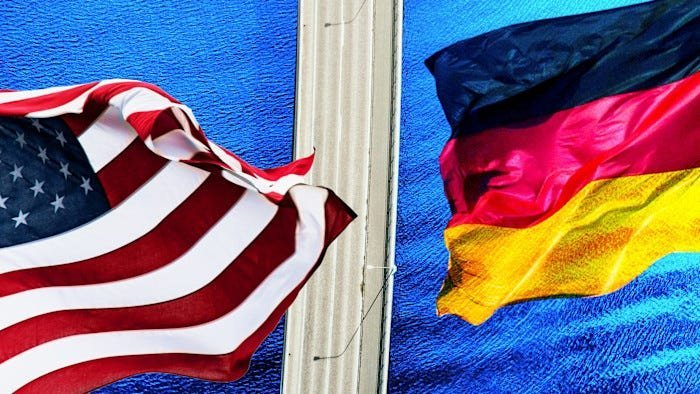
Public confidence in the transatlantic alliance has dropped sharply on both sides of the Atlantic, with 77 percent of Germans now viewing bilateral relations with the United States as bad and American optimism hitting a 10-year low, according to a landmark joint survey released Monday by the Pew Research Center and Germany's Körber-Stiftung.
While 62 percent of Americans still characterize relations with Berlin as good, that figure represents a steep decline from 71 percent in 2025 and 84 percent in 2024, leaving one-third of U.S. adults viewing the partnership negatively. Across the Atlantic, only 21 percent of Germans view ties favorably, mirroring the deep skepticism recorded during the early years of President Donald Trump's first administration and reflecting mounting friction over trade tariffs, defense burden-sharing, and shifting geopolitical priorities during his second term.
The erosion of trust is reshaping how citizens in both nations view global leadership and nuclear deterrence. Sixty-one percent of Germans believe they can no longer rely on the American nuclear umbrella in the event of war, with 69 percent preferring protection from France or the United Kingdom instead, even though 86 percent oppose Germany developing its own atomic weapons. Furthermore, 61 percent of German respondents believe the very concept of Western political and cultural unity no longer exists, and 40 percent now name France as their most important foreign policy partner compared to just 24 percent who choose Washington.
In a striking shift in American public opinion, Canada has emerged as the top foreign policy partner in open-ended polling at 13 percent, nearly doubling from 7 percent last year and surpassing the United Kingdom at 12 percent, Israel at 11 percent, and China at 8 percent, while Germany registered at just 1 percent. Despite the diplomatic chill, 64 percent of Germans and 80 percent of Americans still view U.S. military bases in Germany as vital to national security, marking a 12-point increase in German support for American troop presence since 2019 amid persistent anxiety over Russian aggression.
Threat perceptions and domestic politics continue to divide both electorates as the war in Ukraine drags on. Americans view China as their top security threat at 58 percent followed by Russia at 53 percent, whereas Germans view Russia as their primary concern at 45 percent while only 7 percent view China or the United States as major threats. Partisan lines remain sharp, with American Republicans expressing more positive views of Berlin than Democrats, and supporters of Germany's right-wing Alternative for Germany party showing far greater affinity for both Washington and Moscow than mainstream German voters.