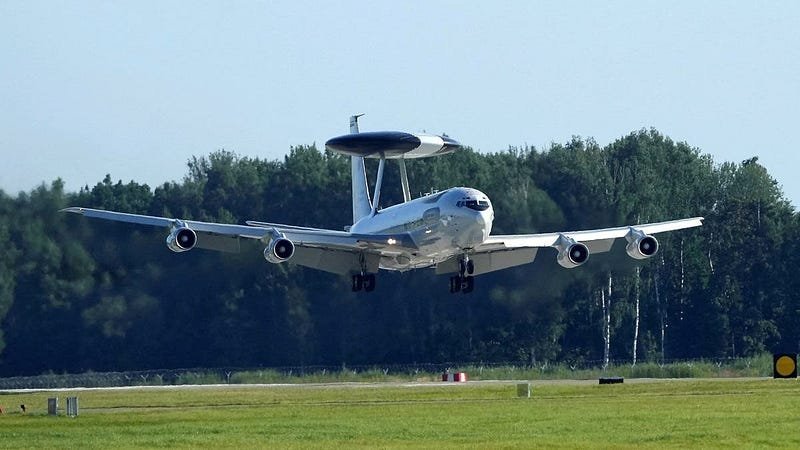
BRUSSELS — NATO authorized the immediate deployment of an Airborne Warning and Control System surveillance aircraft to Poland on Monday following an emergency session of the North Atlantic Council in Brussels, moving swiftly to reinforce air defenses along its eastern flank after three Russian cruise missiles breached Polish airspace and crashed on alliance soil last week.
Polish Deputy Defense Minister Pawel Zalewski confirmed the forward deployment after briefing ambassadors from all 32 member states, noting that the specialized radar plane will give allied commanders far deeper operational awareness to detect and intercept incoming aerial threats. NATO spokesperson Allison Hart later confirmed that Supreme Allied Commander Europe General Alexus Grynkewich signed off on the AWACS mission and is actively evaluating additional military assets to strengthen deterrence across Poland and neighboring frontline states.
The urgent alliance response was triggered during the early hours of Friday, November 20, when Russia launched a massive overnight barrage against western Ukraine. Polish prosecutors and military specialists recovered debris from three Russian Kh-101 cruise missiles manufactured in late 2026 across three southeastern settlements, including Nowy Lipowiec in the Lublin region alongside Rudnik nad Sanem and Molodycz in the Subcarpathian province. Although Polish F-16 fighter jets scrambled during the incursion, commanders opted against firing on the projectiles due to severe weather conditions, and no casualties were reported.
Operating out of Geilenkirchen air base in Germany, NATO's fleet of 14 modified Boeing E-3A Sentry aircraft serves as the alliance's premier eyes in the sky. Equipped with distinctive nine-meter rotating radar domes capable of scanning more than 400 kilometers at any altitude, the planes bypass terrain blind spots to spot low-flying cruise missiles and drones while feeding a unified real-time tactical picture to allied fighter jets, naval vessels, and ground air-defense batteries.
Speaking alongside German Chancellor Friedrich Merz in Berlin on Monday, NATO Secretary General Mark Rutte condemned the airspace violation as an unacceptable and dangerous incident for which Moscow bears full responsibility, while Merz urged the Kremlin to halt reckless provocations. Although Prime Minister Donald Tusk suggested the breach may have been timed to disrupt nearby European military drills, Warsaw stopped short of formally invoking Article 4 emergency consultations as allied planners weigh broader troop and air-defense reinforcements.