Full articles are free to read through December 10, 2026 (IST). Subscriptions remain available.
By S. Vijay Kumar | International Editor, BB News International
In a moment that historians of technology may one day rank alongside the signing of the Bretton Woods Agreement or the birth of the World Wide Web, Prime Minister Narendra Modi today addressed the high-stakes fourth day of the India AI Impact Summit 2026 at Bharat Mandapam in New Delhi, formally unveiling India's MANAV Vision a comprehensive, meticulously architected human-centric doctrine designed to anchor artificial intelligence in ethical, sovereign, and inclusive principles while the landmark gathering simultaneously catalyzed investment commitments exceeding $200 billion, showcased the launch of 12 indigenous foundation models, and crystallized, beyond any remaining doubt, India's emergence as the defining third pole in global AI geopolitics.
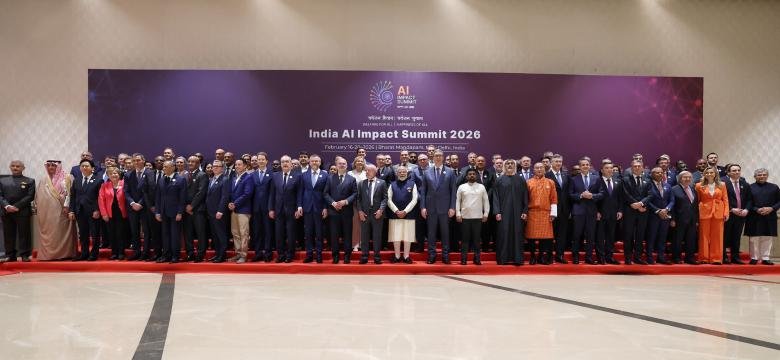
The five-day summit, convened under the IndiaAI Mission from February 16 to 20 and rooted in the ancient Sanskrit ideal "Sarvajana Hitaya, Sarvajana Sukhaya" welfare and happiness for all has made India the first major Global South nation to host a consequential multilateral AI forum of this scale, following its prestigious predecessors at Bletchley Park in the United Kingdom in 2023, Seoul in South Korea in 2024, and Paris in France in early 2025. The New Delhi gathering draws more than 500 global AI leaders, over 20 heads of state including French President Emmanuel Macron and UN Secretary-General António Guterres, 60 ministers, and hundreds of chief technology officers, researchers, academics, civil society representatives, and philanthropists from across the developing and developed world. It is not a diplomatic courtesy; it is a declaration of intent.
In his keynote at the Leaders' Plenary, Prime Minister Modi articulated the MANAV framework an acronym standing for Moral and Ethical Systems, Accountable Governance, National Sovereignty, Accessible and Inclusive AI, and Valid and Legitimate Systems. Declaring artificial intelligence to be "a rare civilizational turning point," Modi underscored that the technology must amplify human potential rather than displace human agency, must be rooted in citizen-owned data and verifiable transparency, and must remain broadly accessible particularly to the underserved billions who have historically been last in line when transformative technologies promised new horizons. "MANAV means human," the Prime Minister declared, positioning the vision as a sovereign safeguard against what he termed "digital feudalism," the emerging risk that a handful of corporations or state actors will arrogate to themselves the power to govern humanity's most consequential technology without democratic accountability or developmental purpose. He reiterated his now-signature call to "design in India, develop in India, and deliver to the world," citing the nation's youthful demographic dividend, deep engineering talent pipeline, decades of public digital infrastructure experience, and accelerating policy clarity as the foundational pillars of India's AI century.
The financial dimension of today's proceedings has been extraordinary even by the inflated standards of the global AI investment boom. Union Minister for Electronics and Information Technology Ashwini Vaishnaw projected more than $200 billion in AI-linked investments flowing into India over the next 24 months, with approximately $90 billion already formally committed or announced during the summit itself figures that, if sustained, would represent one of the largest coordinated capital migrations toward a single emerging-economy technology ecosystem in modern economic history. Reliance Industries Chairman Mukesh Ambani announced a transformative INR 10 lakh crore commitment equivalent to approximately $110–120 billion through Reliance and its Jio platforms over seven years, targeting the construction of green-powered data centers, sovereign compute infrastructure, and AI application layers across consumer and enterprise markets. The announcement carried an unmistakably deliberate echo of Jio's earlier disruption of India's mobile broadband market, which brought internet access to hundreds of millions of Indians at near-zero cost and reshaped the country's digital economy from the ground up.
The Adani Group reaffirmed a $100 billion roadmap extending through 2035 encompassing renewable-energy-powered AI data centers, domestic server manufacturing, sovereign cloud platforms, and allied digital infrastructure a commitment that ties India's AI ambition directly to its clean energy transition and frames computational power as a form of strategic national resource no less vital than oil or rare earth minerals. Google CEO Sundar Pichai announced a $15 billion foundational infrastructure commitment that includes the flagship "America-India Connect" subsea fiber-optic initiative, designed to dramatically reduce latency and strengthen transcontinental data resilience between North America and South Asia, alongside a full-stack AI hub planned for Visakhapatnam. Pichai framed artificial intelligence as the biggest platform shift in human lifetimes comparable in civilizational weight to steam, electricity, or the internet and stressed inclusive scaling as a moral and commercial imperative, not a philanthropic afterthought.
Corporate capital flowed in from every direction. AMD entered a strategic partnership with Tata Consultancy Services for rack-scale AI infrastructure development. Blackstone announced a $600 million equity investment in AI cloud provider Neysa, with additional debt fundraising already planned. Nvidia confirmed collaborations with Indian cloud firms to deploy advanced next-generation processors across India's rapidly expanding compute landscape. Microsoft Vice Chair Brad Smith and Google DeepMind CEO Demis Hassabis joined dedicated sessions on governance and responsible deployment. OpenAI CEO Sam Altman, whose company counts India as ChatGPT's second-largest market globally with more than 100 million weekly users, praised India's credentials for full-stack AI leadership and predicted dramatic further reductions in AI computation costs that would accelerate adoption across the developing world. Tata Sons Chairman N. Chandrasekaran offered perhaps the summit's most resonant industrial framing, describing artificial intelligence as "the infrastructure of intelligence" and calling for its deliberate embedding into India's national productivity engines agriculture, healthcare, logistics, education, and climate resilience as a matter of economic strategy and social obligation simultaneously.
Technological sovereignty was not rhetorical decoration at this summit; it was operational substance. India announced the launch of 12 indigenous foundation models tailored specifically to Indic linguistic and developmental contexts, signaling a strategic and irreversible move away from dependence on externally trained frontier systems designed for other languages, other economies, and other cultural realities. Sarvam AI introduced two landmark large language models a 30-billion-parameter general-purpose system and a larger 105-billion-parameter model alongside multimodal voice, vision, and optical character recognition capabilities supporting all 22 official Indian languages, with a preview of upcoming Sarvam Kaze smart glasses hinting at India's emerging consumer AI hardware ambitions. BharatGen, led by IIT Bombay as part of a government-backed consortium, unveiled Param2, a 17-billion-parameter multimodal model with strong benchmark performance in reasoning, mathematics, coding, and India-specific knowledge domains across all official languages. Gnani.ai showcased advanced conversational and voice AI systems built for multilingual parity across regional dialects that have long been invisible to frontier AI development conducted in the language monocultures of Silicon Valley.
Together, these releases embody India's "Small AI" philosophy a deliberately contrarian approach that prioritizes lightweight, energy-efficient, domain-specific systems optimized for the resource constraints and developmental priorities of emerging economies, over the resource-devouring hyperscale architectures that presuppose infrastructure levels available only to the world's wealthiest nations and largest corporations. The IndiaAI Compute Portal made this philosophy concrete by expanding its public GPU stack beyond 38,000 units with the addition of over 20,000 more, while simultaneously slashing public access pricing to approximately INR 65 per hour roughly $0.78 a cost reduction that effectively democratizes serious AI development for India's burgeoning startup class, its vast academic research community, and the small enterprises that form the backbone of the Indian economy.
Minister Vaishnaw unveiled the New Delhi Frontier AI Commitments a voluntary global cooperation framework that is already endorsed by a broad coalition of international corporations and Indian innovators. Its core provisions include multilingual AI support extending to Global South dialects, accelerated sovereign compute buildup beyond current infrastructure levels, anonymized labor-market data tracking to assess AI's real-time employment impacts before they become crises, rigorous ethical safeguards, and responsible deployment guidelines calibrated for adoption by developing nations without prohibitive compliance costs. The Commitments represent India's most direct bid yet to set the operational rules of inclusive AI governance not merely to endorse frameworks drafted in Brussels or Washington, but to author an alternative vocabulary rooted in developmental necessity.
The diplomatic architecture of the summit proved no less consequential than its financial or technological dimensions. President Macron delivered a carefully crafted address warning against the entrenchment of AI hierarchies of "overlords and vassals" in the emerging global technology order, and advocated with considerable force for a multipolar regulatory architecture that respects national sovereignty while preserving the interoperability upon which global digital trade depends. Secretary-General Guterres praised India for centering what he called the "Global Majority" in the AI governance conversation — a deliberate and significant reframing that places the developmental priorities of the world's poorer nations at the center of AI policy rather than its margins. He pointed specifically to India's deployments of AI for translating court judgments into regional languages and for delivering precision agriculture tools to smallholder farmers as proof that human-centered AI design is not idealism but operational possibility. Bilateral engagements, including Prime Minister Modi's meetings with Swiss leaders on trade, technology, and investment cooperation, reinforced India's deepening strategic alignments across hemispheres and drew the European center of multilateral governance closer to New Delhi's emerging AI leadership orbit.
Switzerland's confirmation that it will host the 2027 AI Summit in Geneva is itself a statement of considerable institutional significance. It confirms that the rotating global AI governance forum which began at Bletchley Park in 2023 as a largely Western enterprise focused on existential AI risk has now evolved into a genuinely multilateral institution, its agenda shaped in meaningful part by India's insistence on shifting the conversation from risk management for wealthy nations toward opportunity realization for developing ones. The institutionalization of this forum is among the summit's most durable legacies.
Human capital development and youth mobilization were not peripheral subplots but structural commitments woven into every dimension of the summit's programming. The YUVAi Challenge Grand Finale brought together young innovators from 60 countries presenting AI-driven solutions for climate adaptation, rural healthcare delivery, and agricultural productivity a deliberate signal that the next generation of consequential AI builders will not be confined to the campuses of Stanford, MIT, or Tsinghua. Organizers announced that nearly 250,000 students and researchers across India signed a digital pledge for Responsible AI Innovation, a campaign that earned Guinness World Records recognition and embedded ethical awareness into the foundational identity of India's rapidly expanding AI talent pipeline. The India AI Impact Expo, spanning over 300 exhibitors from more than 30 countries across pavilions dedicated to healthcare, agriculture, education, and sustainable industries, demonstrated through hundreds of concrete deployments that artificial intelligence generates its most enduring value not in abstract benchmark competitions but in measurable outcomes for real communities.
From Washington's vantage point where this correspondent has observed successive waves of technology-driven geopolitical realignment over many years the India AI Impact Summit 2026 represents something qualitatively different from a funding milestone or a diplomatic photo opportunity. It represents the crystallization of a genuinely new center of AI narrative authority. By integrating ethical doctrine, sovereign infrastructure ambition, multilingual inclusion architecture, unprecedented private capital flows, and a coherent developmental philosophy rooted in democratic values and public institutional experience, New Delhi is articulating a model of AI governance that diverges from both the American tradition of laissez-faire corporate primacy and the Chinese model of state-directed centralization. India's emerging approach is market-driven but publicly scaffolded, commercially ambitious but ethically framed, globally connected but indigenously rooted and it arrives with a democratic legitimacy that neither of the current AI superpowers can easily replicate or dismiss.
Whether the MANAV Vision can ultimately hold together its twin commitments to accelerated commercialization and durable accountability will depend on factors that no summit declaration can guarantee: sustained regulatory execution beyond the event's floodlights, research depth that translates into competitive frontier capability, equitable distribution of benefits that reaches India's villages and not merely its tier-one technology clusters, and the patience to build the global trust that transformative governance authority requires over time. These are not trivial challenges, and India's history with ambitious policy frameworks counsels measured expectations alongside genuine admiration.
Yet on this day, in this hall, the resonance from Bharat Mandapam is unmistakable, and it travels well beyond New Delhi. India has served notice that it is no longer content to be a consumer of artificial intelligence architectures conceived elsewhere, governed by rules written for others, and calibrated to serve economies vastly different from its own or those of the broader developing world. It is positioning itself with growing confidence, growing capital, and growing capability as architect, convener, and moral interlocutor for the unfolding AI century. The message it is sending to Geneva, Brussels, Washington, Beijing, and every capital in the Global South is as direct as it is historic: technological power must serve humanity's collective progress, or it will have failed its most fundamental test. India intends to make sure it does not.