Full articles are free to read through December 10, 2026 (IST). Subscriptions remain available.
By S Vijay Kumar, International Editor | 18th February 2026
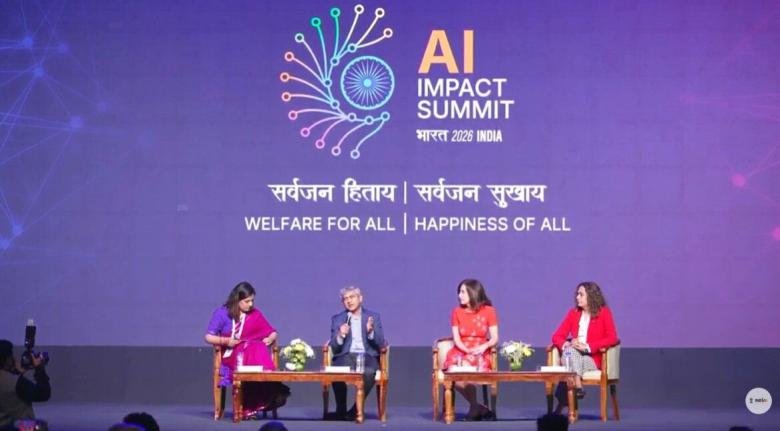
NEW DELHI, As the India AI Impact Summit 2026 reached its midpoint in New Delhi's sprawling Bharat Mandapam complex, the event solidified India's bold claim to leadership in shaping a more inclusive and equitable global AI landscape. Now in its third day of a five-day gathering (February 16–20, with the Expo extended to February 21 due to overwhelming public interest), the summit has drawn an unprecedented array of tech titans, heads of state, ministers, researchers, and civil society representatives from over 100 countries marking the first major international AI convening hosted in the Global South.
Under the resonant mantra "From Vision to Action: India Leading the AI Impact Movement", the summit is anchored in three core principles or "Sutras" of People, Planet, and Progress. These translate into seven thematic "Chakras" guiding multilateral action: Human Capital, Inclusion for Social Empowerment, Safe & Trusted AI, Science, Resilience/Innovation/Efficiency, Democratizing AI Resources, and AI for Economic Development & Social Good. The framework emphasizes shifting AI discourse from abstract promises to tangible, measurable outcomes that prioritize human dignity, environmental sustainability, and equitable prosperity.
The event's scale is staggering: over 500 sessions, more than 840 exhibitors (including 300+ at the flagship India AI Impact Expo 2026 across 10+ thematic pavilions and 13 country pavilions from nations like Australia, France, Japan, Germany, and others), and participation from over 20 heads of state/government, 60+ ministers, and 500+ global AI leaders. The Expo, spanning 70,000 square meters, features innovations in healthcare, agriculture, education, energy, gender empowerment, and accessibility many drawn from flagship challenges like AI for ALL (partnered with Startup India), AI by HER (with NITI Aayog's Women Entrepreneurship Platform), and YUVAi (youth-focused with MY Bharat and NIELIT).
February 18 spotlighted the Research Symposium, co-organized with IIIT-Hyderabad as knowledge partner, bringing together academics, practitioners, and policymakers from India and the Global South to present frontier research, share evidence, and build collaborations. Sessions emphasized interdisciplinary work on AI's societal impact, including policy-relevant applications in health, agriculture, energy, education, and accessibility. Sectoral AI Impact Casebooks launched earlier in the week documented over 170 scalable innovations, serving as practical blueprints for deployment.
Other highlights included the Finance and Philanthropy Plenary (with World Bank involvement), discussions on democratizing financial access via AI, and side events from partners like the UN's Office for Digital and Emerging Technologies (ODET), featuring a high-level townhall on AI reshaping global development beyond the SDGs. Tech announcements flowed steadily: NVIDIA revealed partnerships with Indian computing firms, while broader commitments underscored investments in compute infrastructure under the IndiaAI Mission (₹10,372 crore budget), which has deployed 38,000+ GPUs at subsidized rates (₹65/hour) with plans to add 20,000 more.
The summit's star-studded attendee list includes Sundar Pichai (Google/Alphabet), Sam Altman (OpenAI), Jensen Huang (NVIDIA), Dario Amodei (Anthropic), Sir Demis Hassabis (Google DeepMind), Brad Smith (Microsoft), Alexandr Wang (Meta), Arthur Mensch (Mistral AI), and Indian luminaries like Mukesh Ambani (Reliance), Nandan Nilekani (Infosys), Kiran Mazumdar-Shaw (Biocon), and Ashwini Vaishnaw (Minister of Electronics & IT). Discussions stressed sovereign AI capabilities, ethical governance, and bridging the North-South divide echoing calls for collaborative frameworks that empower emerging economies.
Prime Minister Narendra Modi, set to deliver the inaugural address on February 19 (following a welcome reception for international leaders on February 18 evening), has already articulated a visionary ambition: positioning India among the top three AI superpowers globally by 2047 not merely as a consumer but as a creator of models and infrastructure. In pre-summit remarks, he emphasized "Sarvajana Hitaya, Sarvajana Sukhaya" (welfare for all, happiness for all), framing AI as a tool for human-centric progress in healthcare, education, agriculture, governance, and enterprise. The IndiaAI Mission, he noted, ensures code that reflects Indian values while democratizing access.
The summit's momentum reflects India's strategic push: a massive talent pool, proven digital infrastructure (e.g., UPI), and macroeconomic stability position it as a bridge between advanced economies and the Global South. Projected economic impacts from AI initiatives reach $1.7 trillion, with technology revenue exceeding $280 billion.
Yet amid the optimism, a minor but widely reported controversy briefly overshadowed proceedings: Galgotias University was directed to vacate its Expo stall after a staff member presented a commercially available Chinese robotic dog (Unitree Go2, priced ₹2-3 lakh) as an original "Orion" innovation from the university's Centre of Excellence. The misrepresentation quickly identified by online users and covered by outlets like NDTV, Reuters, and The Associated Press prompted swift action from organizers, with power reportedly cut to the stall. The university issued clarifications denying claims of building the device, attributing the issue to unclear communication, but the incident sparked debate on research ethics, transparency, and the risks of overhyping "Made in India" claims at a summit celebrating indigenous innovation.
Organizers downplayed the episode as isolated, noting it has not disrupted the broader agenda. Livestreams continue on the official IndiaAI YouTube channel, ensuring global access despite occasional site access issues.
As voice grows for responsible, inclusive AI amid rapid adoption worldwide the India AI Impact Summit 2026 stands as a pivotal moment. By prioritizing Global South perspectives, practical applications, and equitable frameworks, New Delhi is not just hosting a conference but asserting leadership in defining AI's future for humanity.