Full articles are free to read through December 10, 2026 (IST). Subscriptions remain available.
By S Vijay Kumar, International Editor | 18th February 2026
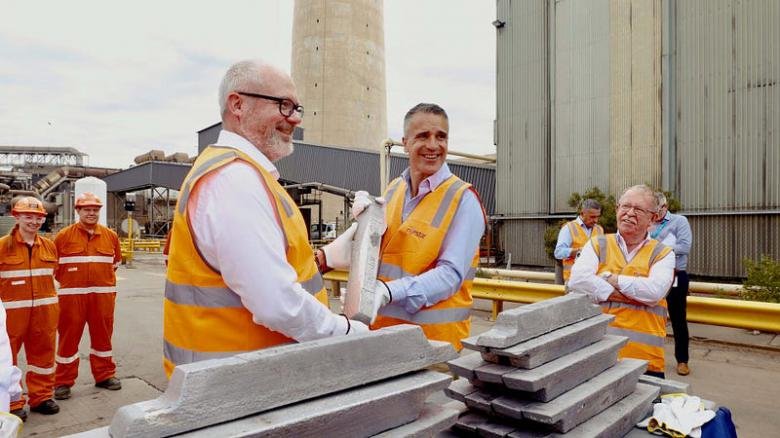
In a decisive step toward reducing global dependence on concentrated critical mineral supplies, Australia today celebrated a major industrial milestone: the first commercial shipment of high-purity antimony metal from the revitalized Nyrstar Port Pirie smelter in South Australia. The landmark delivery achieved six months ahead of initial projections stems from a $135 million tripartite investment announced in August 2025 by the Albanese Labor Government, the South Australian Government under Premier Peter Malinauskas, and the Tasmanian Government, matched by Nyrstar’s own capital commitment to modernize its historic Australian operations.
Antimony, a silvery metalloid classified as a critical mineral by both Australia and its key allies, plays an indispensable role in defense applications (flame retardants for military equipment, munitions additives), semiconductors (doping agents for high-performance chips), renewable energy technologies (lead-acid battery enhancement and emerging photovoltaic applications), and automotive components (lead-acid starter batteries and advanced alloys). With China currently dominating more than 50 percent of global antimony production and refining, today’s shipment marks a tangible advance in building diversified, resilient, and geopolitically secure supply chains for Western democracies and their industrial partners.
The inaugural batch is destined for an Australian east-coast manufacturer, providing domestic industry with a reliable onshore source that previously relied entirely on imports. Future consignments will target export markets in Europe, Asia, and crucially the United States, directly supporting customers in sectors vital to national security and the clean energy transition. The project aligns seamlessly with the US-Australia Critical Minerals Framework, under which Nyrstar’s antimony production at Port Pirie has been formally recognized, and with Australia’s Critical Minerals Strategic Reserve priorities that designate antimony as a top-tier strategic material.
“This achievement demonstrates the power of decisive government-industry collaboration to deliver rapid results,” said Minister for Industry and Innovation and Minister for Science Senator the Hon Tim Ayres. “In just six months, we have turned investment into tangible output—creating secure regional jobs, boosting Australia’s value-adding capacity, and strengthening the global critical minerals supply chain. This is the Future Made in Australia in action: leveraging our abundant resources, skilled workforce, and world-class facilities to produce more of what the world needs, right here at home.”
Premier Peter Malinauskas of South Australia, whose state hosts the Port Pirie facility, underscored the broader economic and strategic implications. “This first shipment is the realization of our vision to diversify South Australian industry and open entirely new export pathways,” he stated. “We are positioning South Australia as a key contributor to global supply chains for minerals essential to AUKUS-related industrial growth, the clean energy revolution, and advanced technologies. Nyrstar stands ready to expand production not only of antimony but also bismuth, tellurium, germanium, and indium materials that will underpin the next wave of defense, semiconductor, and renewable energy innovation.”
The Port Pirie smelter, a cornerstone of the region’s economy for more than a century, employs approximately 1,050 workers representing roughly 10 percent of the local workforce. The modernization effort has preserved and enhanced these high-quality regional jobs while positioning the facility as a flagship site for critical minerals processing. By upgrading existing infrastructure rather than building from scratch, the project exemplifies efficient, low-risk capital deployment that maximizes Australia’s legacy assets in minerals processing.
The timing of the announcement carries added weight amid escalating global competition for critical minerals. Western governments and industries have grown increasingly concerned about supply-chain vulnerabilities exposed by geopolitical tensions, export restrictions, and concentrated production. Australia’s emergence as a reliable, rules-based producer of antimony directly addresses these risks, offering an alternative source that aligns with the strategic priorities of the United States, European Union, Japan, South Korea, and other Quad and AUKUS partners.
Industry analysts view the Port Pirie milestone as a bellwether for Australia’s broader critical minerals strategy. The nation holds some of the world’s largest reserves of key materials—including lithium, rare earths, cobalt, nickel, and now strengthened antimony processing capacity and is aggressively pursuing downstream value-adding to move beyond raw commodity exports. By investing in smelting, refining, and advanced manufacturing, Canberra aims to capture greater economic returns, create skilled employment, and build sovereign industrial capabilities essential for national security and net-zero ambitions.
For global markets, the shipment signals improved supply diversity at a moment when demand for antimony is surging. Applications in flame-retardant textiles, military pyrotechnics, infrared detectors, and next-generation battery technologies ensure steady growth, while supply disruptions elsewhere have driven price volatility. Australia’s entry as a stable, transparent producer is expected to exert downward pressure on risk premiums and foster long-term contracting relationships with Western buyers.
The Albanese Government has framed this success as proof of concept for its “Future Made in Australia” agenda a comprehensive policy framework designed to accelerate investment in clean energy, advanced manufacturing, and critical technologies. By combining public co-investment with private capital, targeted tax incentives, and international partnerships, the strategy seeks to position Australia as an indispensable player in the 21st-century industrial economy.
As the first antimony ingots leave Port Pirie bound for domestic and international customers, the achievement reverberates far beyond South Australia’s industrial heartland. It stands as a concrete example of how middle powers, through strategic foresight and collaborative financing, can help reshape global supply chains in favor of resilience, transparency, and shared security. In an era defined by strategic competition over resources, today’s milestone underscores that diversified production not protectionism or confrontation offers the surest path to a stable, prosperous future for industries and nations alike.