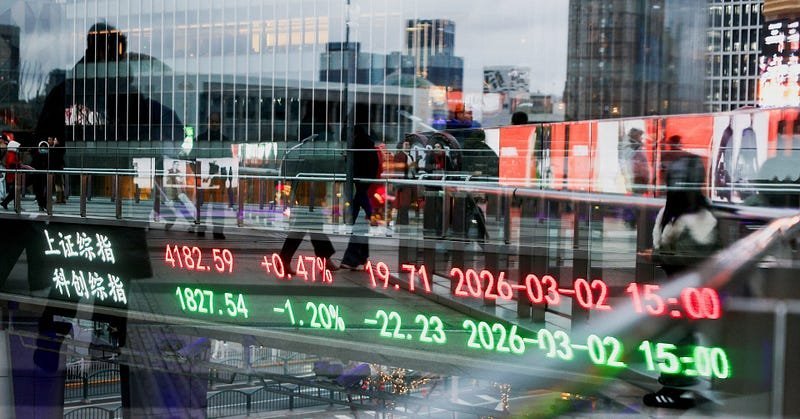
TOKYO / SEOUL / MANILA, — Asia-Pacific equity markets staged a broad Friday morning rebound on November 27, 2026, shaking off a week-long technology sell-off as semiconductor and consumer giants led regional indices higher across Tokyo, Seoul, Sydney, and Hong Kong. In early trading, Japan's benchmark Nikkei 225 climbed 0.7 percent to 57,919.30, Australia's S&P/ASX 200 gained 0.4 percent to 8,800.50, and South Korea's Kospi surged 2.2 percent to 4,812.65 as investor anxiety eased following sharp fluctuations earlier in the week triggered by Anthropic's market debut and leadership shifts at Nvidia. The sole regional outlier was New Zealand, where equities dipped after final special vote tallies confirmed a hung parliament in Wellington, leaving Prime Minister Christopher Luxon's ruling coalition one seat short of a majority and reliant on the centrist Opportunity Party to avoid a second election.
Corporate dealmaking and major corporate setbacks dominated Tokyo market action as shares of Japan Tobacco rallied more than 4 percent following reports that the company is exploring a joint takeover bid alongside U.S. tobacco giant Altria for Britain's Imperial Brands, whose stock jumped 13 percent in London. The potential transatlantic acquisition comes as Japan Tobacco absorbs an $8.9 billion financial hit after the Russian government seized all seven of its local subsidiaries amid worsening bilateral tensions between Moscow and Tokyo over the arrest of a Japanese journalist on espionage charges. Meanwhile, global commodity traders across Asia closely tracked rising crude oil prices after Houthi strikes on a Saudi Arabian oil refinery temporarily halted operations, compounding supply anxieties ahead of next month's U.S. Federal Reserve policy meeting where speculation is mounting over a potential 50-basis-point interest rate hike.
Across Southeast Asia, fresh economic and aviation headwinds underscored shifting trade dynamics along Pacific supply chains. Official trade figures released in Manila on Friday revealed that the Philippines' trade deficit widened to a record $6.95 billion in October as imports surged, even as the United States remained the country's top export destination at 26.1 percent while China reclaimed its spot as the top import supplier. At the same time, AirAsia Philippines confirmed a round of workforce reductions on Friday, citing sustained aviation fuel expenses and foreign exchange pressures, while DHL reported that port congestion across key Asia-Pacific maritime hubs including Manila showed measurable operational improvement in November.
For U.S. institutional investors, multinational supply chain directors, and global market strategists in New York and Washington, Friday's market recovery highlights the resilience of Asian technology equities even as geopolitical friction, Middle East energy shocks, and Federal Reserve tightening risks reshape capital flows across the Pacific Rim entering December.