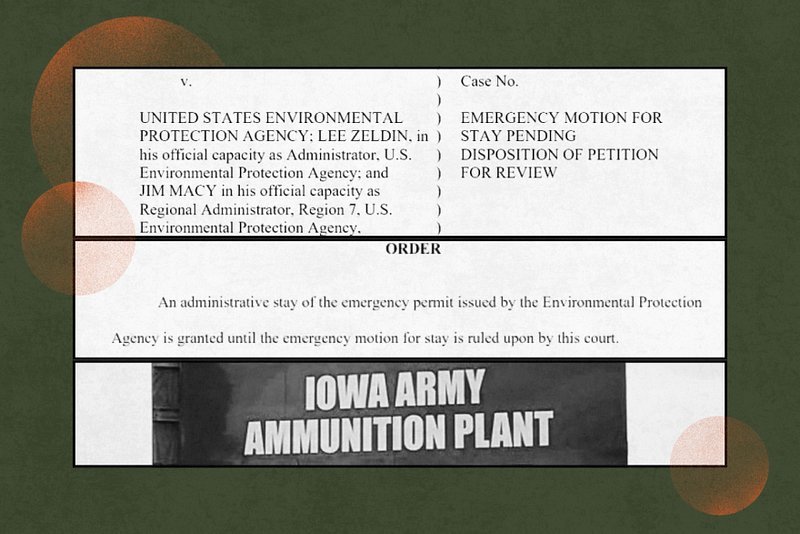
The U.S. Army has postponed for a second time its controversial plan to detonate nearly five tons of degraded lead azide at the Iowa Army Ammunition Plant in Middletown, announcing late Sunday night that the controlled blast will now take place on Wednesday, November 25, 2026. Defense officials stated via social media that the move from Monday to Wednesday is necessary to ensure optimal weather conditions and finalize extensive mitigation measures around the southeastern Iowa facility. The announcement caps a dramatic weekend legal standoff in which the U.S. Department of Justice notified a federal appeals court that the military intends to invoke emergency regulatory authority to carry out the explosion regardless of a temporary judicial stay blocking its environmental permit.
The high-stakes operation centers on 68 barrels containing roughly 9,700 pounds of lead azide, a volatile primary explosive stored inside a Middletown bunker for more than two decades. Military munitions technicians discovered in March 2026 that the stabilizing mixture of water and ethanol inside the drums had evaporated, causing hazardous needle-shaped crystals to form. According to court declarations from Army experts, this recrystallization has rendered the stockpile extraordinarily sensitive to friction, shock, and sudden temperature fluctuations, making it too dangerous to open or transport the barrels. With regional temperatures forecast to plunge below 30 degrees Fahrenheit this week and the bunker's protective blast doors already removed in preparation for disposal, Justice Department lawyers warned the 8th U.S. Circuit Court of Appeals that the only realistic choice is between a mitigated controlled detonation and an unplanned, catastrophic explosion.
Environmental advocates and state officials have mounted fierce resistance to both the open-air disposal method and the military's handling of public notifications. Following a lawsuit filed by the Iowa Environmental Council and the Sierra Club Iowa Chapter, represented by Earthjustice, the federal appeals court issued an administrative stay last Thursday pausing the emergency permit granted by the U.S. Environmental Protection Agency. In renewed court filings on Sunday, plaintiffs' attorneys accused the Army of attempting to sidestep judicial review without explaining why it previously abandoned a cleaner chemical neutralization contract that would have dissolved the explosives without generating a toxic blast plume. Elected leaders across the Midwest—including incoming Iowa U.S. Senator-elect Josh Turek and Illinois U.S. Senator Tammy Duckworth—have joined critics in condemning the military's delayed communication with local residents.
Public health anxiety remains acute across eastern Iowa and neighboring Illinois ahead of Wednesday's rescheduled blast. Military dispersion models indicate the detonation could send an airborne plume containing roughly 6,900 pounds of toxic lead particles drifting up to 60 to 100 miles depending on prevailing winds, while also producing powerful ground vibrations and shockwaves capable of shattering nearby windows. The Iowa Department of Health and Human Services and the Centers for Disease Control and Prevention emphasize that no safe level of lead exposure exists, posing heightened neurological risks to young children and pregnant women.
In response to the looming blast, Iowa Governor Kim Reynolds has activated the state emergency operations center, while the Federal Aviation Administration has imposed temporary flight restrictions over Middletown through Wednesday. Local families inside the immediate evacuation zone have begun sealing windows, relocating livestock, and leaving town ahead of the operation, while state and federal agencies prepare real-time atmospheric plume maps to guide residents. As the Wednesday deadline approaches, the Middletown detonation stands as both an urgent public safety operation and a flashpoint over military accountability and environmental transparency in the American heartland. www.bbnewsin.com