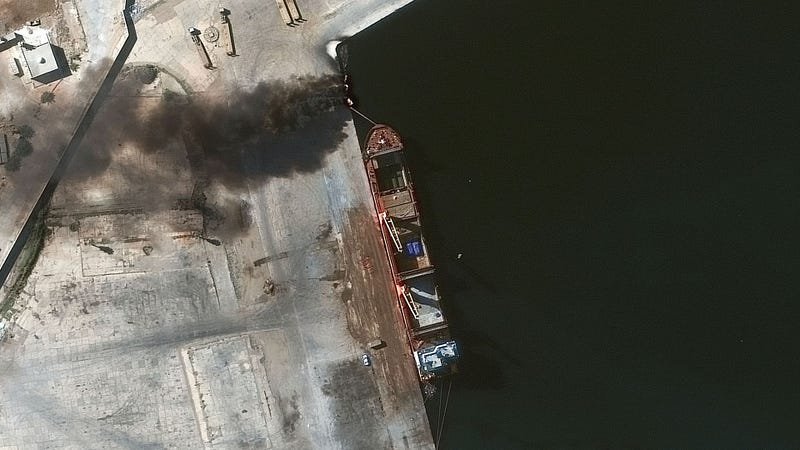
A Russian navy warship has capsized and partially sunk at a naval base in eastern Libya after being struck in a suspected Ukrainian sea drone attack early Sunday, November 22, according to Libyan officials and commercial satellite imagery. Identified by defense analysts and satellite imagery providers as the Project 20380 Steregushchiy-class corvette Merkury, the vessel was moored at the Benghazi Naval Base for refueling and resupply when explosive-laden unmanned surface vessels breached port defenses and triggered a massive explosion and fire. Libyan military officials affiliated with eastern commander Khalifa Haftar's Libyan National Army reported that air and naval units intercepted at least four incoming drones before two struck the corvette, while a secondary drone strike hours later damaged a Maltese-flagged commercial ship off the Benghazi coast. For defense strategists in the United States and NATO capitals, the strike represents a dramatic geographic expansion of the nearly five-year Russia-Ukraine war more than a thousand miles away from the Black Sea.
Satellite images captured Sunday by Vantor and Planet Labs confirmed extensive devastation inside the Benghazi port facility, showing the heavily damaged Merkury rolled onto its side with only its bow remaining visible above the waterline and debris scattered across the adjacent pier. Although Kyiv has maintained operational silence and Moscow has yet to issue an official response, preliminary investigations by eastern Libyan authorities indicate the sea drones were launched from western Libya, where Ukrainian special forces operatives have reportedly operated out of bases near Misrata to target Russia's maritime logistics and shadow fleet. Built to escort convoys and conduct coastal patrols, the Merkury had been operating alongside Russian government-linked transport ships used to supply Moscow's Africa Corps mercenary network and regional arms shipments following Russia's loss of naval basing access in Syria.
The attack immediately exposed the deep political fault lines dividing oil-rich Libya since the 2011 NATO-backed uprising that toppled Moammar Gadhafi. Libya's eastern-based Government of National Stability, which maintains close military and maritime cooperation agreements with Moscow, condemned the strike as a blatant violation of national sovereignty and maritime safety, announcing a joint investigation with Russian counterparts to identify the perpetrators. Simultaneously, the rival United Nations-recognized Government of National Unity in Tripoli voiced grave concern over foreign powers dragging Libyan ports and civilian infrastructure into external conflicts, warning against allowing international actors to use Libyan territory as a theater to settle military scores.
Sunday's dramatic sinking in the Mediterranean capped a bruising weekend for Russian maritime assets across two separate European and African theaters. Just one day earlier on Saturday, November 21, two drones struck the Russian cargo vessel Sparta II in the Baltic Sea near Finland's waters, sparking a prolonged fire that forced the evacuation of its crew and prompted Finnish Prime Minister Petteri Orpo to warn that the war is spilling dangerously close to Nordic borders. Together, the back-to-back strikes in the Baltic and Mediterranean seas underscore Ukraine's growing capability to project asymmetric naval drone warfare far beyond its own coastline.
As the United Nations Support Mission in Libya calls for an immediate, independent, and transparent investigation into both Benghazi maritime strikes, Washington and European allies are closely watching how Moscow and Haftar's forces respond. Having previously accused Ukraine of using Libyan territory to strike the Russian liquefied natural gas tanker Arctic Metagaz in March 2026, Kremlin planners now face mounting vulnerability across their vital Mediterranean supply corridor linking Russian ports to military operations across North and sub-Saharan Africa.