Full articles are free to read through December 10, 2026 (IST). Subscriptions remain available.
BB news International Reporter | 20th February 2026
In a decisive step toward the commercial debut of its newest widebody aircraft, The Boeing Company has secured initial qualification for its 777-9 flight training simulators from both the U.S. Federal Aviation Administration and the European Union Aviation Safety Agency, clearing the way for regulator-approved pilot instruction on the next-generation jet.
The dual approvals signal regulatory confidence in the fidelity, safety architecture and performance modeling of the 777-9 training ecosystem, positioning Boeing to advance toward full operational readiness for airline customers worldwide. The qualification certificates authorize the use of Boeing’s state-of-the-art simulator devices for structured training validation, an essential prerequisite before airlines can begin formal pilot transition programs.
For Boeing, the milestone underscores years of engineering collaboration and regulatory scrutiny focused on ensuring that the 777-9’s advanced cockpit technologies are seamlessly mirrored within its training infrastructure.
“Securing these approvals is an important step as we prepare for the start of flight training,” said Capt. Gary Mandy, 777X chief technical pilot. “Pilots will benefit from an immersive training experience that will help ensure our customers’ operational readiness for the 777-9.”
The simulators, housed at Boeing’s Training Campus in Gatwick, are among the most sophisticated ever developed for a commercial aircraft program. Designed in collaboration with global simulation leader CAE, the devices include a full-flight simulator and an advanced flight training device capable of replicating the 777-9’s flight characteristics, systems logic, environmental variables and operational contingencies with high precision.
The initial qualification granted by regulators confirms that the devices meet stringent international standards governing motion cueing, visual systems, avionics modeling and failure simulation accuracy. Such certification ensures that pilot responses within the simulator environment translate reliably to real-world flight operations.
Chris Broom, vice president of Commercial Training Solutions at Boeing Global Services, described the achievement as both technical and strategic. “The qualification of these training devices underscores our commitment to delivering high-quality training solutions that meet the needs of global airline customers and regulators,” he said.
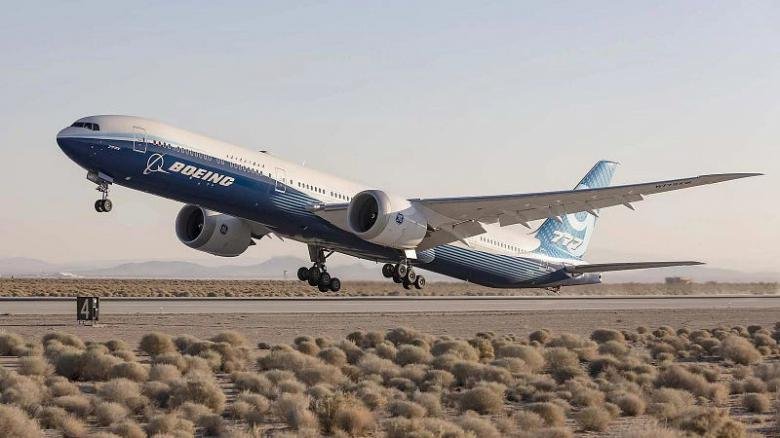
The 777-9 represents the first member of Boeing’s 777X family, engineered to combine the proven reliability of the 777 platform with technological advancements derived from the 787 Dreamliner program. Its flight deck architecture reflects that philosophy of continuity and innovation.
Among the cockpit enhancements are large-format, high-resolution displays equipped with touchscreen capability, offering pilots a modernized interface designed to streamline information management and reduce workload. The aircraft also offers the option of dual head-up displays, similar to those used on the 787 Dreamliner, providing critical flight data within the pilot’s forward field of view to enhance situational awareness during takeoff, landing and low-visibility operations.
A redesigned pilot seat emphasizes ergonomic support and long-haul comfort, while a distinctive control and indicator system has been introduced for the aircraft’s folding wingtips — a defining structural feature of the 777X series. The system clearly signals whether the wingtips are extended, in transition or folded, a vital safeguard during ground operations at airports with existing gate infrastructure.
Integration of portable tablet-based Electronic Flight Bag capability further modernizes cockpit workflow, allowing digital charts, manuals and performance calculations to be seamlessly incorporated into flight operations.
The training devices replicate each of these elements in detail, enabling pilots to develop muscle memory and procedural proficiency before ever stepping into the actual aircraft. The simulators’ software models flight dynamics, aerodynamic behavior and environmental conditions — including turbulence, wind shear and system malfunctions — providing crews with exposure to a full spectrum of operational scenarios.
According to Alexandre Prevost, President of Civil Aviation at CAE, the qualification reflects years of joint development between simulation engineers and aircraft specialists. “This qualification is the result of a multi-year effort between CAE and Boeing’s leading experts,” Prevost said. “We’re excited to continue this strong collaboration as we deliver full-flight simulators to our mutual customers around the world.”
Following this initial regulatory qualification, authorities will utilize the devices to validate the full training curriculum and courseware. That process ensures that lesson plans, checklists, emergency procedures and type-rating programs align precisely with the aircraft’s certified design and operational profile. Only after this validation phase can airlines formally begin pilot training for commercial service entry.
Industry analysts view the development as a critical checkpoint in the 777-9 certification timeline. Training infrastructure readiness is widely regarded as one of the final gateways before aircraft delivery and route deployment, particularly for long-haul widebody fleets serving international markets.
For Boeing, headquartered in Arlington, Virginia, the milestone carries additional symbolic weight as the manufacturer continues reinforcing regulatory alignment and operational transparency across its commercial programs. The synchronized approvals from both the FAA and EASA demonstrate transatlantic regulatory coordination, a key factor for airlines operating in multiple jurisdictions.
The 777-9 is positioned to serve high-capacity, long-range routes with improved fuel efficiency and lower emissions compared to earlier-generation widebodies. Its composite wing, advanced GE9X engines and optimized aerodynamics are expected to deliver enhanced performance economics for carriers navigating competitive global markets.
As airlines prepare for fleet renewal cycles and post-pandemic capacity recalibration, the readiness of pilot training systems becomes central to maintaining safety standards and minimizing transition time between aircraft types.
The simulator qualification at Gatwick signals that Boeing’s training ecosystem is moving in lockstep with aircraft development, reinforcing the company’s emphasis on operational preparedness.
Boeing describes itself as a leading global aerospace company and one of the top U.S. exporters, serving customers in more than 150 countries across commercial aviation, defense and space sectors. The company states that it remains committed to core values of safety, quality and integrity as it advances next-generation aircraft programs.
With regulators now approving the 777-9’s training devices, Boeing edges closer to a pivotal chapter in widebody aviation — one where advanced simulation, digital integration and human-centered cockpit design converge to shape the next era of long-haul flight.